On this page
The garage door is the largest single opening in most Perth houses, and on a lot of estate homes it is a thin steel skin facing west. Whether insulating it is worth doing depends on what sits behind it. This guide covers what garage door insulation does, the difference between an insulated panel door and a retrofit kit, what can and cannot be done with a roller door, and why insulation on its own does not fix a draughty garage.
What does garage door insulation actually do?
It slows heat moving through the door. A plain steel door is a conductor: the outer skin takes on whatever temperature the sun and the air give it and passes that straight through to the inside face, which then warms or cools the air in the garage. Put a layer of foam between the outer skin and the garage and the transfer slows down. The garage no longer swings as far, or as fast, as the weather outside. In practice that shows up in three ways.
- A more even temperature. The garage warms more slowly through a hot afternoon and lets that heat go more slowly overnight; on a winter morning it is milder than the air outside.
- Less condensation. On a cold, clear morning the inside of a bare steel door drops below the dew point and sweats, and the drips land on whatever is stored under it. A foam-backed panel stays closer to the temperature of the garage air, so less moisture forms.
- Less noise. Foam fixed to the skin stiffens the panel, so it does not drum in wind or rain, and it takes the edge off street noise coming through the door.
What insulation does not do is stop air moving. Heat, dust and rain that come through the gaps around the door are a sealing problem, covered further down. One more thing to settle early: insulation is rated by the people who make it, and the figures depend on the material, its thickness and how it is fitted. We do not publish figures of our own. When you compare doors or kits, ask for the maker's data sheet and compare like with like.
Is garage door insulation worth it in a Perth summer?
Stand in a west-facing garage in Ellenbrook or Baldivis at five o'clock on a February afternoon and you will have your answer. The door has been in full sun since lunchtime. Steel takes on that heat quickly, a dark colour more so, and radiates it into the garage from the inside face like a panel heater. The garage becomes a heat store, and on most estate homes, with a bedroom or living area on the other side of the wall, that heat leaks into the house through the shared wall and the internal door for hours after sunset. The air conditioner fights it all evening.
An insulated panel door changes that afternoon. The outer skin still gets hot, but the foam core slows the heat reaching the inside face, so the garage air warms more slowly and less of it ends up in the house. It works the other way round in July, when a north-westerly brings rain and a bare door would let the garage sit close to the outside temperature all night.
The honest caveat is that the door is one part of the garage envelope. If the garage has no ceiling insulation, a single-skin wall to the outside and a gap under the door you could post a letter through, the door alone will take the edge off the afternoon rather than transform the room. It makes the biggest difference when the garage is already reasonably enclosed, or when it is used as a room in its own right: a workshop, a home gym, a teenager's retreat, or the spot where the second fridge and the chest freezer run hard all summer.
What are the options: an insulated panel door or a retrofit kit?
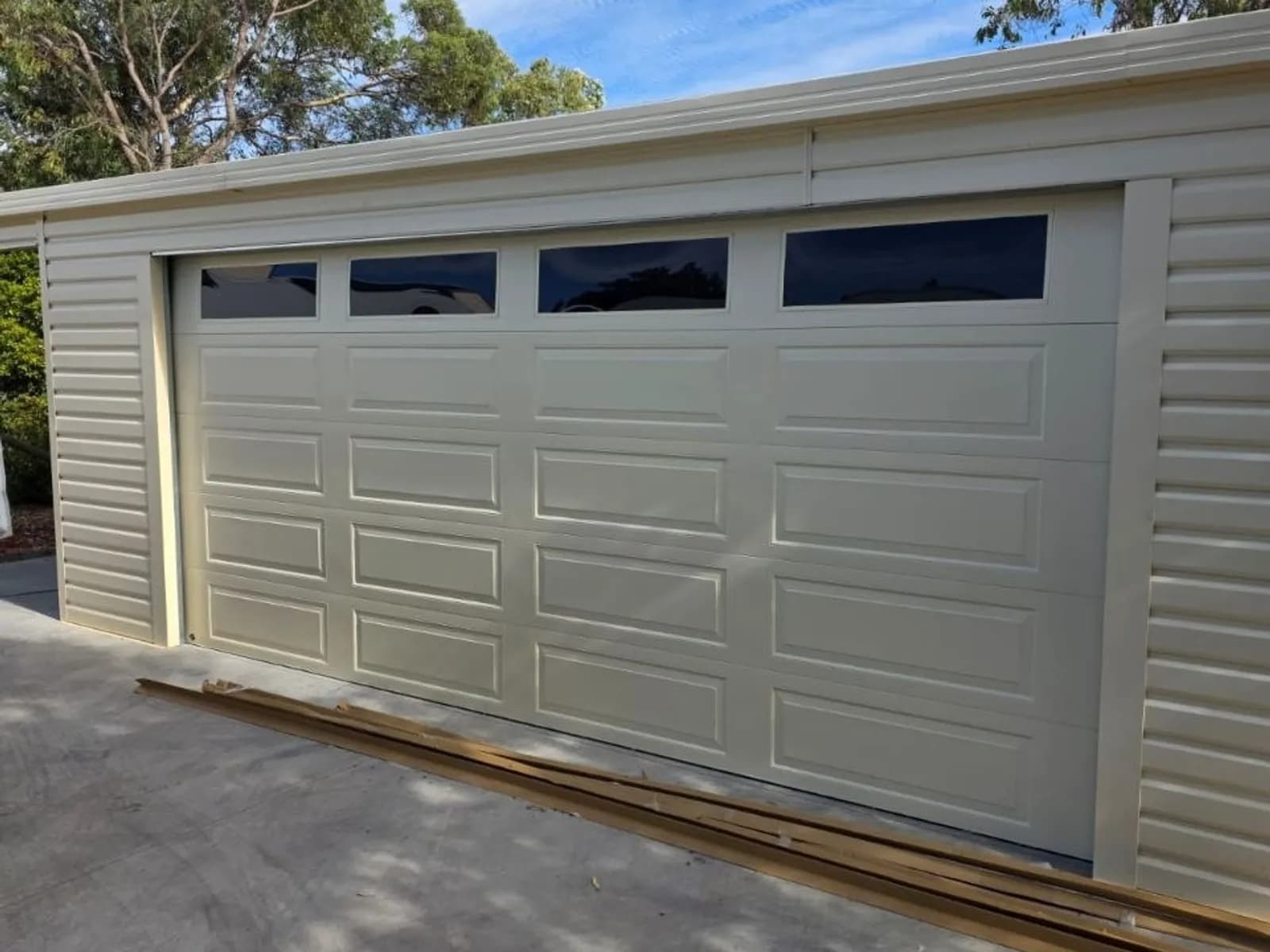
There are two routes, and they suit different situations. An insulated panel door is a sectional door whose panels are made with a foam core sandwiched between two steel skins at the factory. The insulation is inside the panel, out of sight, and the panel is stiffer and quieter for it. Steel-Line, B&D and Centurion Garage Doors each offer insulated panel ranges alongside their standard doors and publish the performance figures for their own products. The insulated garage doors we supply and fit across Perth come from those ranges.
A retrofit kit is fitted to a door you already have. Rigid foam boards, usually faced with foil or vinyl, are cut to fit inside each panel recess of a sectional door, between the stiles, and held with adhesive, tape or clips. Some products are flexible peel-and-stick sheets rather than boards. The kit route makes sense when the door itself is in good condition and you are not ready to replace it. What to weigh up between the two:
- Weight. A kit adds weight the springs were never set for. The door can feel heavy on the release cord and the opener works harder every cycle. Have the balance checked after fitting.
- Fit and finish. A factory panel is finished on the inside. A kit shows joints, tape and facing, and boards can work loose as the adhesive ages in a hot garage.
- Coverage. Boards cover the panel recesses, not the stiles, the hinge lines or the panel edges. A factory panel is insulated edge to edge.
- Lifespan. The foam in a factory panel lasts as long as the panel. A kit is disturbed every time a panel is repaired or replaced.
- Compatibility. Some door makers state which add-ons they accept on their doors. Read that before fixing anything to a door you may want the maker to stand behind later.
Can you insulate an existing roller door?
Sometimes, within limits, and it is the question we are asked most often about insulation. A roller door curtain is a single corrugated steel sheet that wraps around a drum above the opening. Anything attached to it has to bend with the curl every time the door opens, add as little as possible to the thickness of the roll, and not add so much weight that the spring inside the drum can no longer balance the door.
That rules out rigid boards. Thin, flexible peel-and-stick sheeting is made for roller doors and can be fitted to a curtain in good condition, but there are things to check first: whether the roll has room to grow before it rubs on the brackets, the lintel or the pelmet; whether the corrugation profile lets the sheet follow the curve without lifting at the edges; and whether the spring can be re-tensioned to carry the extra weight. On a tired door with a worn spring and a scraping curtain, the honest answer is that it is not worth it.
There are alternatives. Insulated roller shutters with foam-filled slats exist, mostly in commercial and industrial ranges rather than domestic doors. And if the garage is used as a room, swapping the roller door for an insulated sectional door when the roller door is due for replacement gives a far better result than sticking material to the curtain. If you are weighing those two door types up, our comparison of roller doors and sectional doors sets out the practical differences.
Insulated vs uninsulated sectional and tilt doors: what is the difference day to day?
On a sectional door, the difference shows up in three ways you can feel. The inside face is not hot to the touch after an afternoon of sun. The door does not boom when a gust hits it or a car door slams in the driveway. And the panels are stiffer, so the door runs with less flex and rattle in the tracks. Most sectional garage doors in Perth are now offered with an insulated panel as a standard option rather than a special order, and a new door is the easiest point at which to choose it.
A tilt door is a one-piece panel that swings out and up on pivot arms. Older tilt doors, common on brick-and-tile homes in Morley, Midland and Armadale, are usually a steel or fibre-cement sheet on a timber or steel frame with the back left open. Boards can be fitted between the frame members, and the flat, open frame makes the job more straightforward than a sectional door. The catch is the same one: weight. A tilt door's counterbalance springs are set for the panel as it left the factory, and adding boards across the whole face changes that. The door can fly up or drop if the springs are not adjusted, and adjusting tilt door springs is a technician's job, not a Saturday one.
Added weight changes the balance of the door
Any insulation fixed to an existing door adds weight the springs were not set for. After fitting a kit, pull the release cord, lift the door to about waist height and let go. If it drops or drifts up, stop using the opener and have the springs adjusted. Do not re-tension springs yourself on a sectional, roller or tilt door.
Does insulation help with noise as well as temperature?
Yes, in two different ways. A single steel skin is a drum: wind, rain and hail set it ringing, and every hinge and roller rattles through it into the house. A foam core glued to both skins damps that, so the door is quieter in weather and quieter in operation. It also blocks some airborne noise from the street, which matters when the door faces a main road in Canning Vale or Joondalup and a bedroom sits behind the garage.
Two things to keep in mind. Much of the noise a garage door makes comes from worn rollers, dry hinges and a chain-drive opener bolted straight to the ceiling, and insulation does nothing for those; a service does. And noise, like heat, also comes around the door through the gaps, so a well-insulated panel with perished seals still lets the neighbour's mower in.
Insulation is not sealing: how do the two work together?
Insulation slows heat passing through the door. Seals stop air passing around it. They are different jobs done by different parts, and a garage needs both before it feels any different. The bottom seal takes up the gap between the door and an uneven slab; the side and top seals close the gap between the door and the frame or the brickwork; a pelmet covers the roll or the top panel and the gap above it.
In Perth the seals matter as much as the insulation. An afternoon easterly pushes hot air and dust in under a worn bottom seal, a winter front drives rain under it, and the gap along the top of a sectional door lets the garage breathe outside air all day. Fitting an insulated door and leaving the original perished seals in place is like fitting double glazing and leaving the window open. Our guide to garage door seals covers which seal goes where and how to tell when one has had it, and the bottom, side and top seals we carry suit most roller and sectional doors.
How do you choose the right option for your door?
Start with the door you have and what the garage is for, and the choice usually makes itself.
- Door due for replacement, or a new build: choose an insulated sectional door from the maker's range and have new seals fitted with it.
- Sectional door in good condition, garage used as a room: a kit is a reasonable interim step. Have the balance and opener force checked after it goes in.
- Roller door: flexible sheeting if the curtain, the spring and the clearances allow it; otherwise plan for an insulated sectional door when the roller door is replaced.
- Tilt door: boards between the frame members, with the counterbalance springs adjusted afterwards by a technician.
- Garage used only for the car: start with the seals and a look at the ceiling insulation before spending on the door.
- Dark, west-facing door: think about colour and insulation together. A lighter colour takes on less of the afternoon sun to begin with.
We are based in West Perth and fit and service doors in every Perth suburb, north and south of the river. We supply, install and service Steel-Line, B&D and Centurion Garage Doors, including their insulated panel ranges, and we can look at an existing door and tell you plainly whether a kit or a new door is the sensible call. The quote is free, there is no call-out fee, and we price the job before we start.