On this page
Garage door springs lift every door in Perth, from a roller door in Midland to a double sectional in Canning Vale, and they are the part nobody looks at until one lets go. Here is how the three spring systems work, how to tell which you have, how long they last and why the swap is a technician's job.
What do garage door springs actually do?
A garage door is heavy. The springs are wound or stretched to push back with almost exactly its weight, which is why a balanced door lifts with one hand and stays where you leave it. The opener never lifts the weight; it only pulls a balanced door along its tracks. When a spring breaks, the motor is asked to lift the whole door and stalls or strips its gear trying.
The motor is not the muscle
Many suspected motor failures are spring failures. If the opener hums, lifts the door a hand-span and gives up, check the springs before you price a new motor.
Which spring system does your garage door use?
Australian garages use three door styles, each carrying its springs in a different place, and the spring system decides how the door fails and what the repair involves.
Sectional doors: torsion springs on a bar
A sectional door is the hinged-panel door. Above the opening runs a shaft with one or two torsion springs on it and a cable drum at each end; closing the door winds the springs tighter, and opening lets them unwind to turn the drums and reel the door up on its cables. Double doors normally carry two springs wound in opposite directions, and a few older or lighter sectional doors use extension springs along the horizontal tracks instead.
Tilt doors: springs on the side arms
A tilt door is one rigid panel that swings out and up, common on brick-and-tile homes in Morley, Midland and Armadale. It is balanced by heavy springs on the pivot arms at each side, which load up as the door closes and pull it open again. The two sides work independently, so a tired spring on one side makes the door drag or twist. We do tilt door spring and arm repairs across these older suburbs.
Roller doors: tension inside the drum
A roller door is a curtain that wraps around a drum above the opening, with its springs hidden inside that drum. They are wound by turning the drum a set number of turns, and that preload is the drum tension. Over the years it settles, the door gets heavier and stops staying half-open, and eventually a spring cracks. Resetting the tension means taking the weight of the whole curtain, and an old, rusted curtain is sometimes better replaced.
How do you tell which spring type you have?
Close the door, put the light on and look above the opening from inside; you do not need to touch anything.
Spotting your spring system
- A bar across the top with one or two tight coils and a drum at each end: sectional door, torsion springs.
- Long springs beside the horizontal tracks near the ceiling, with a pulley and cable each side: extension springs.
- One solid panel that tips outward as it opens, with springs on arms at the sides: tilt door.
- A curtain that rolls into a drum and no springs in sight: roller door, springs inside the drum.
Are torsion springs better than extension springs?
For most doors, yes. A torsion spring lifts through the shaft and drums, so both sides rise together, and when it breaks it stays on the bar. Extension springs act independently, so they wear unevenly and the door lifts crooked, and a snapped one can whip across the garage unless a safety cable runs through it. Torsion springs are also generally rated for more cycles. In practice the door's design decides, and most sectional doors sold in Australia use torsion springs.
Extension springs need a safety cable
Look for a thin steel cable threaded through each extension spring and anchored at both ends; it catches the spring when it snaps. If the cables are missing or loose, have them fitted at the next service.
How long do garage door springs last?
Springs are rated in cycles, not years. One cycle is one open and one close, and standard springs are commonly rated at around 10,000 cycles as a general industry figure. Twice a day is roughly 700 cycles a year, so a quiet door lasts a decade or more; a busy family door running six cycles a day wears the same spring out in a handful of years, and a shopfront roller door in Osborne Park or Wangara needs springs rated for far more. Rust, balance and the fit of the spring decide whether a door reaches that count at all.
Why do springs rust sooner in coastal Perth?
The afternoon sea breeze carries fine salt well inland. Salt pits the steel rather than eating it evenly, and on a wire under high stress every time the door moves, each pit is a notch where a crack starts and grows with every cycle until the coil lets go. Doors in Scarborough, Hillarys, Fremantle and Cottesloe are the most exposed, the same salt shortens the life of the lift cables, and a light film of oil on the coils twice a year is the simplest defence.
What are the signs a garage door spring is failing?
Springs give some notice before they break and plenty after. More than one of these means book a check.
- A loud bang from the garage, often at night: a torsion spring snapping.
- A gap of a few centimetres in the coil on the bar.
- The door feels heavy by hand, will not stay half-open, or the opener lifts it a hand-span and reverses.
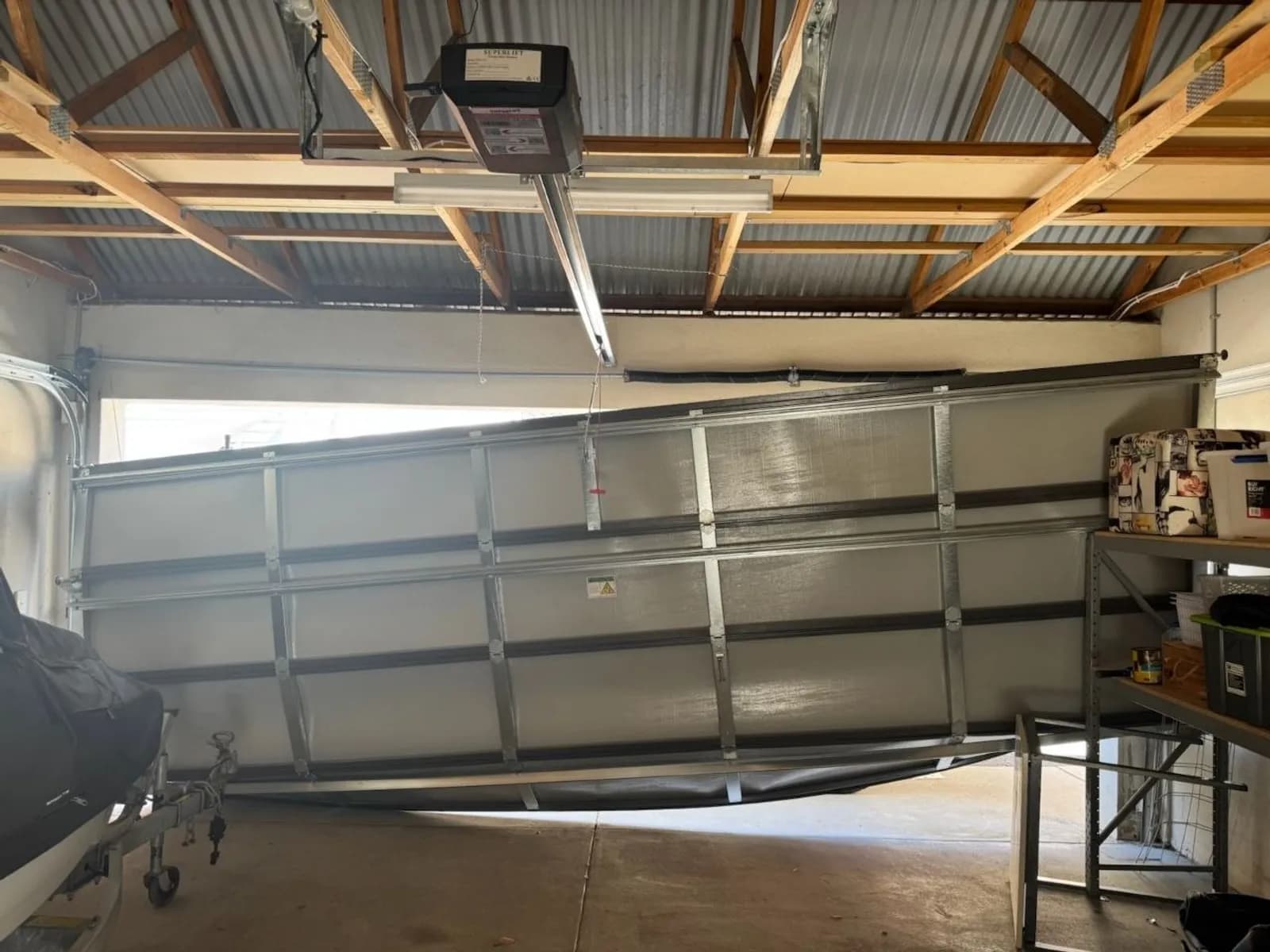
- The door sits crooked or has jammed on an angle in the tracks.
- Lift cables hanging slack, frayed or off their drums.
- Rusty, pitted or unevenly stretched coils, or grinding from the bar even after oiling.
What should you do when a spring breaks?
Stop using the opener. Running it on a broken garage door spring loads the motor with the door's full weight and can pull the cables off the drums and jam the door in its tracks. Do not lift a double sectional door by hand either; without its springs it is dead weight. Our page on what to do right now with a broken spring or cable covers the first ten minutes, and because the cables usually jump the drums when a spring lets go, refitting or replacing the lift cables is normally part of the same visit.
If the car is trapped inside
Leave it there; forcing the door up is how people get hurt. We run more than one van across Perth, each carrying the common spring sizes, so a broken spring is usually sorted in one visit, same day, any day of the year, with no call-out fee.
Why are garage door springs a technician's job?
Stored energy. A torsion spring wound for a double sectional door holds enough to lift that door. It is wound with steel bars in the cone at its end, and if a bar slips or a set screw lets go it unwinds in a fraction of a second and takes the bar with it. Roller door drums and tilt door arms are no gentler. That is why this guide gives no turn counts: the right number depends on the door's weight, height and drum size. Technicians, our owner with 20 years in the trade among them, use matched bars, a stable platform and unload a spring fully before touching a set screw.
Why replace both springs, and why match them to the door?
When one spring on a two-spring door breaks, the other has done the same cycles in the same salt air and is not far behind, so we fit them as a matched pair. Matching a garage door torsion spring means measuring the wire diameter, inside diameter and length of the old one, noting which way it is wound, and weighing the door with the springs unloaded, since added panels, cladding or insulation change it. We replace springs on Steel-Line, B&D, Centurion, Gliderol and most other makes; the torsion, extension and roller door spring types page shows the options, and you can book a same-day spring replacement anywhere in Perth with a free quote and the price agreed before we start.
How do you keep garage door springs healthy?
Two habits cover most of it: oil the coils and check the balance. Twice a year, spray a garage door lubricant or light machine oil along each spring and wipe off the drips; keep grease out of the tracks, where it only collects sand. Then run the balance test, which is safe to do yourself as long as no spring is broken.
- Close the door fully, then pull the red release cord to disconnect it from the opener.
- Lift the door by hand to about waist height and let go gently.
- A balanced door stays put or drifts a little; dropping means the springs are tired, climbing means they are over-wound.
- Lower the door and run the opener so the trolley picks it up again.
- If it failed, do not adjust anything; book a service and tell us what it did.
Never release the opener with the door up
Only pull the release cord when the door is fully closed. With a weak or broken spring, a door released while open has nothing holding it. If it is stuck open, leave it on the opener and call.
A yearly service catches the rest: tired springs, frayed cables and an opener whose force setting has been turned up to hide a heavy door. Our guide to how often a garage door needs a service covers the intervals; coastal and high-use doors need one more often.