On this page
A roller door has fewer moving parts than any other garage door, which is why so many Perth carports and sheds have one, and why most people search how to fix a roller door before they ring anyone. The curtain is one ribbed sheet of steel that runs in a guide down each side of the opening and coils around a drum above it, with a spring inside the drum carrying the weight. When something goes wrong it is nearly always one of those three parts, and each tells on itself differently. This is roller door troubleshooting the way we do it on a driveway, from what you can safely put right yourself to the point where forcing the door starts costing you a new curtain.
Why is a roller door not rolling up properly?
Watch and listen as the door moves; the symptom narrows the cause faster than anything else.
- Scrapes or grinds the whole way: sand in the guides, a dry guide or worn guide liners. The most common fault and the easiest to fix.
- Jams at the same height every time: a dent in one guide, a screw head standing proud, or a crease in the curtain catching there.
- One side runs ahead and the curtain twists: guides out of plumb, the curtain shifted on the drum, or one edge already out of its guide.
- Heavy to lift, will not stay put, or drops when let go: the spring has lost tension or broken inside the drum. Not a guide problem.
- The roll above the opening looks fat and loose and rubs the brackets: the curtain is ballooning on the drum.
- The motor hums, strains or trips out part-way: the door is binding or out of balance and the opener is being asked to drag it.
- Will not move at all by hand: the lock is on, the motor is still coupled, or the curtain is caught.
If the door is motorised, pull the manual release first and try it by hand. A door that runs cleanly by hand has an opener problem; a door that is heavy, stiff or catching by hand has a door problem, and no work on the motor will cure it.
Can you fix a roller door yourself, and what is safe to try?
Some of it, yes. The line is simple: anything you can do with the door closed and the drum left alone is fair game. Anything involving the spring, the drum, the axle clamps or lifting a curtain that has lost its tension is not, because the drum is wound up under load whether the door is open or shut. This is the routine we would give a mate.
- Release the motor and run the door through a full cycle by hand, noting where it goes tight.
- With the door closed, look down inside each guide with a torch. Sand, leaves and rust flakes collect in the bottom, where the curtain edge runs.
- Clear the guides with a vacuum nozzle or stiff brush, hose the curtain and guides, and let them dry.
- Spray a dry silicone or PTFE lubricant down each guide and along the curtain edges. Never grease or oil a guide; it holds the sand and turns it into grinding paste.
- Tighten any loose screws on the guides and brackets; a loose guide is one of the main reasons a curtain jumps out. Leave the clamps on the drum alone.
- Sight up each guide from the bottom. Both should be straight and plumb, with the same gap between them top and bottom.
- Look over the curtain for creases, split ribs or a bottom rail rusting through, and photograph anything you find.
Do not touch the spring or the drum
The spring inside a roller door drum is wound hard enough to lift the whole curtain, and if a clamp slips while it is being adjusted the drum spins back and the curtain drops. We do not give instructions for that step. What you can safely do is notice when the door feels heavier than it used to, and have it looked at before the spring gives up completely.
How do you put a roller door curtain back in its guides?
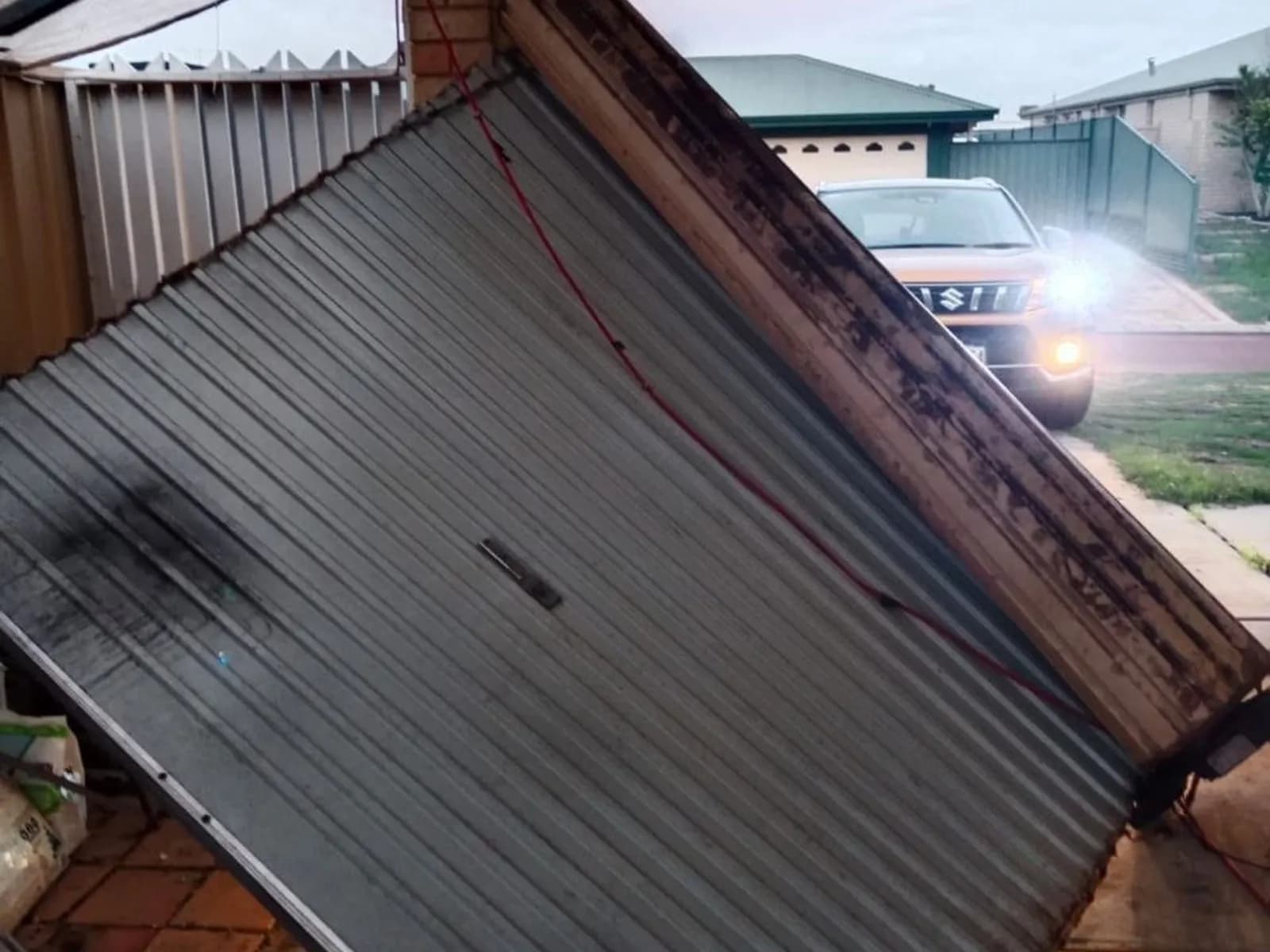
A roller door off track is the fault in the photo on this page: one edge of the curtain has climbed out of its guide. Whether you can put it back yourself depends on how far up it happened and why. If only the bottom few ribs have popped out at the foot of one guide, the motor is released, the sheet is not creased and the door still moves freely, you can usually ease the edge back into the channel by lifting the curtain a little with one hand and guiding the edge in with the other while someone steadies the door. Wear gloves; curtain edges are sharp and often rusty.
Stop and ring us if the curtain came out above knee height, the motor has run since, the sheet is creased, the guide is bent, or the door dropped and has clearly lost its tension. Then the curtain has to be re-seated from the top with the weight taken properly, the guide straightened or replaced and the spring checked. The immediate steps are the same as for any garage door that has come off its tracks: stop using it and keep the opening clear. Forcing a curtain into a bent guide creases the sheet, and a creased curtain never rolls flat again. The reason it came out matters as much as the fix: a curtain does not leave its guide on its own, so unless the loose guide, the shifted curtain or the bin left in the doorway is dealt with, it will be out again within the month.
What makes a roller door balloon or run unevenly?
Two faults get bundled under the word uneven. Ballooning is when the curtain coils loosely instead of wrapping tight, so the roll above the opening is bigger than it should be, rubs the brackets or pelmet, and often leaves the door a little open at the bottom because the slack has to go somewhere. Coning is when the coil telescopes sideways on the drum; one edge of the curtain then runs deeper in its guide than the other, drags, and eventually climbs out.
Both come back to the same short list: the spring is no longer pulling the curtain tight onto the drum, the clamps holding the curtain to the drum wheels have loosened and let it creep sideways, the guides are out of plumb, or an opener is set to over-travel and pushes the curtain past the point where it stays tight. What you can check is that the guides are plumb and firmly fixed and that a motorised door is not being driven past its natural top stop. The tension and the drum clamps you cannot safely fix, because correcting a ballooning or coning curtain means re-seating it on the drum with the spring under control. That is a normal one-visit job for us.
Why has the curtain unravelled off the drum, and is that a DIY fix?
A roller door unravelled is the one that gives people a fright: the curtain has come partly or wholly off the drum and hangs in the opening, sometimes with the spring tension gone with it. It happens when the clamps holding the top of the curtain to the drum wheels work loose, when a motor drives the door past its top limit and pushes the curtain off the end of the coil, or when a door is forced up by hand against a lock or a jam. A curtain that had been ballooning for months is often how it starts.
This one is not a DIY fix. Reattaching a curtain means supporting the full weight of the sheet while it is fixed back to the wheels and the spring brought back to tension, and if the spring let go when the curtain came off, the drum has to come down to find out why. Switch the opener off at the power point, keep people and the car away from the opening, do not try to lift or roll the curtain by hand, and ring. If it hangs into the driveway, a couple of chairs and some tape stop anyone walking into it until we arrive.
What are the most common roller door faults in Perth garages?
Perth wears roller doors out in a particular order, and where the house is tells us a lot before we open the van door.
- Sand in the guides, worst on the sandy blocks north of the river and along the coast. It grinds the curtain edges and guide liners and makes the scrape owners live with for years. Cleaning and a dry lubricant fix most of it; once the liners are worn through, the guide needs relining or replacing.
- Salt corrosion on coastal doors, from Yanchep down through Hillarys and Scarborough to Fremantle. The bottom rail rusts first, then the curtain edges hidden inside the guides, then the spring and fittings in the drum. A rusty spring loses tension faster and breaks sooner.
- Tired springs and opened-up guides on the 1990s and 2000s estate doors in Ellenbrook, Canning Vale and Joondalup. The door goes heavy and the curtain starts to wander.
- Loose fixings on older brick homes in Morley, Midland and Armadale, where guide screws went into soft mortar or plugs that have crumbled, so the guide leans away from the curtain.
- Curtains creased by cars, bins and trailers. A fold along a rib catches in the guide on every cycle from then on.
- Openers doing the spring's job. A heavy door is masked for a year or two by a motor strong enough to drag it, until the motor gives up and the real fault shows.
Steel-Line, B&D and Centurion Garage Doors roller doors are the ones we supply, install and service, and these faults turn up on every make; we repair the others too. Guides wear rather than break, and the roller door guides and tracks we fit cover the common sizes.
How do you fix a noisy or stiff-rolling roller door?
Noise on a roller door is friction, and friction lives in three places: where the curtain edges run in the guides, where the curtain wraps onto itself on the drum, and where the drum wheels turn on the axle. Start with the guides, because that is where the sand is. Clean them, hose the curtain and use a dry silicone or PTFE spray. A door that quietens for a week and then scrapes again has worn guide liners or a guide pinching the curtain; look for a bright wear line down one edge of the sheet. Stiffness without much noise tends to be a guide slightly too tight or bent; if the door always frees up at the same height, something is standing proud in the channel there.
A rumble or knock from the top of the door as it coils is usually the drum end: dry drum wheels, a loose bracket, or the curtain slapping the pelmet because it is ballooning. A squeal at the start of every lift is often a dry axle bush. Those are technician items, because getting at them means working around the drum. A bang followed by the door going heavy is the spring, and the door should not be used until it is looked at. The generic checks for a noisy garage door cover sectional and tilt doors as well; on a roller door the guides are nearly always the answer.
When is it a spring problem rather than a guide problem?
The balance test settles it. With the motor released, lift the door by hand to about waist height and let go gently, keeping your hands close. A door with the right tension stays put or drifts a little. A door that sinks or drops has lost spring tension; a door that wants to fly up has too much. Neither is a guide fault, and cleaning the guides will not change it. Guide faults show up as noise, catching, jamming at one height or one side running ahead; spring faults show up as weight.
The two overlap in one way. A door running on low tension drags on the guides because the curtain is no longer held tight on the drum, so it scrapes and jumps out and the guides get blamed. If the door is noisy and heavy, treat the heaviness as the primary fault. Our guide to the signs a roller door spring needs re-tensioning covers what to look for and what happens on the visit; it is a quick job when the spring is still sound.
When should you stop and call a technician?
Roller doors reward a bit of owner maintenance and punish being forced. Stop, switch the opener off and ring when any of these is true.
- The door has gone heavy, drops when let go, or you heard a bang from the drum.
- The curtain is out of its guide above knee height, or the motor has run since it came out.
- The curtain is ballooning, coning or has unravelled off the drum.
- A guide is bent or has pulled away from the wall, or the curtain is creased where it catches.
- The bottom rail or curtain edges are rusting through.
- You have cleaned and lubricated the guides and the scrape or jam came back within weeks.
- The motor strains or trips out even though the door moves freely by hand.
Every extra cycle on a door that is binding or out of balance costs a bit more curtain, the one part of a roller door that cannot be patched. We carry springs, drum wheels, guides, locks and common opener parts on the van, so most faults on this page are roller door repairs we finish in one visit, same day, any day of the year, with no call-out fee and the price agreed on the driveway before we start. If the door is past saving, you are told so plainly and given the figure for a new curtain or a new door alongside the repair.