On this page
Most roller door complaints we hear across Perth, from a shed door in Ellenbrook to a double roller in Joondalup, come down to tension: the door has gone heavy, will not stay up, or slams into the stops. If you searched how to tension a roller door, this is not a winding guide. It explains what tension is, how to tell whether yours is low or high, what you can safely check, and why the winding itself is our job.
What does tension mean on a roller door, and what is the spring doing?
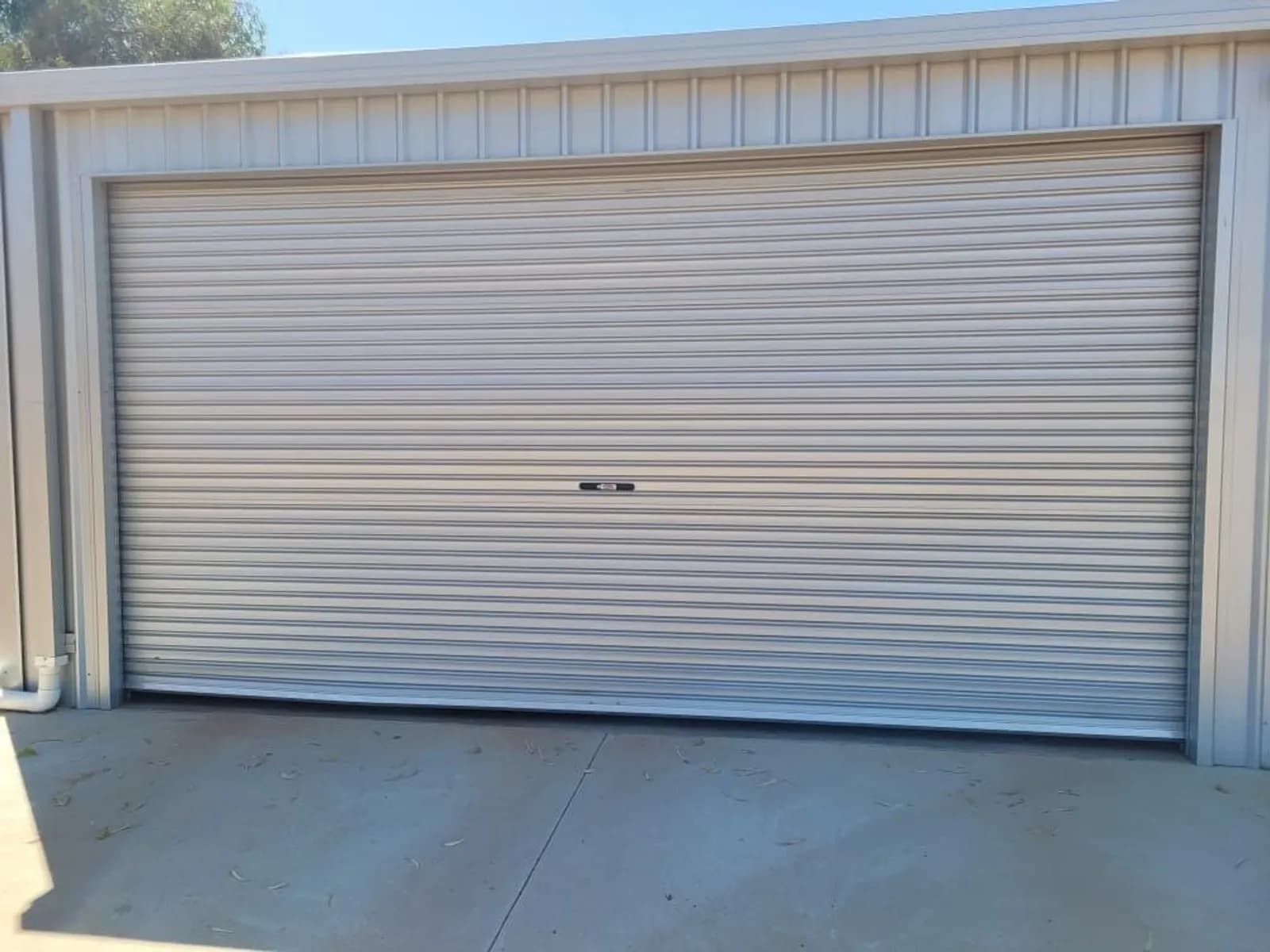
A roller door is a steel curtain that wraps around a drum above the opening. Inside that drum, out of sight, sits a coil spring fixed to the axle at one end and the drum at the other. At installation the drum was turned against the spring before the curtain was attached, and that twist is the tension. As the door comes down, the curtain winds the spring tighter; as it goes up, the spring unwinds and helps roll the curtain back on.
The aim is balance. The spring should push up with close to the weight of the curtain at every point of travel, so the door is nearly weightless in your hands and an opener only has to nudge it along. The motor never does the lifting, which is why a roller door that has lost tension will stall or wear out a perfectly good opener. Our guide to the three spring systems used on Australian garage doors covers how this compares with sectional and tilt doors.
What are the signs a roller door has lost tension?
Springs settle over years of cycles, and the salt the sea breeze carries inland pits the steel on coastal doors in Scarborough, Hillarys and Fremantle, so tension rarely stays where the installer set it. Low tension shows up as weight.
- The door feels heavy to lift by hand, and heavier the closer it gets to the ground.
- Lifted halfway and let go, it drifts or drops instead of staying put.
- It creeps down on its own when left open.
- The opener strains, slows near the bottom, or stops and reverses part-way up.
- The curtain lands with a thud rather than settling on the floor.
A door that has gone from fine to dead heavy overnight is different: the spring has probably cracked rather than settled. Stop using the opener and read what to do right now with a broken spring or cable first.
What are the signs a roller door is over-tensioned?
Too much preload is less common but harder on the door, and it is no safety margin: an over-wound spring is under more stress on every cycle and fatigues sooner. It usually follows a well-meant adjustment, a spring sized for a heavier curtain, or a curtain replaced with a lighter one without the tension being reset.
- The door springs open hard and needs holding back rather than lifting.
- It bangs into the stops at the top of its travel.
- Pulling it down takes real effort and it wants to climb back up; left halfway, it rises on its own.
- The opener labours on the way down and the curtain bounces or jerks near the floor.
- The stop brackets look bent from repeated impacts.
Why does a roller door balloon, cone or run unevenly?
Ballooning is the curtain bulging out between the guides as the door rises instead of rolling tight onto the drum. The drum is not taking the curtain up as fast as it is leaving the floor, which usually points to tension too low for the curtain, dry or worn guides dragging on the edges, or an opener driving the door faster than the drum can wind. Left alone, a ballooning door scuffs its paint, catches in the guides and can jump out of them.
Coning is the curtain telescoping sideways on the drum so one end of the roll sits higher than the other, and the door climbs or drags on one side. It comes from uneven pull between the two ends: a drum wheel slipped along the axle, brackets no longer level, one guide packed with sand, or two springs on a double door wound unevenly. Both are worth fixing early, because a curtain that runs crooked for months creases and never rolls flat again.
What can you safely check yourself, and what should you never touch?
Plenty of roller door trouble is not spring trouble, and you can rule that out without going near the drum. Do these with the door closed and the opener switched off.
Safe owner checks
- Run a torch down both guides and clear sand, leaves and grit with a dry rag; no grease.
- Look for bent or spread guides, loose fixings, a bowed bottom rail and dents in the curtain that catch as it moves.
- Look up at the drum wheels and axle brackets for rust, cracked welds or a bracket pulling off the wall.
- Listen to a full cycle: a grinding drum or a squeal from one side tells you where to point the technician.
Then run the balance test. Close the door fully, disconnect the opener with the release cord, lift the door by hand to about waist height and let go gently. A balanced door stays close to where you left it; one that drops has too little tension, one that climbs has too much. Reconnect the opener with the door down and book the adjustment. A manual door takes the same test without the release step. For faults that are not tension-related, our page on common roller door problems and how to sort them covers the rest.
Never touch these three things
The spring inside the drum, any bar or tool in the drum spokes, and the tension itself. Do not release a roller door from its opener while it is open, do not loosen axle U-bolts or bracket bolts to see what happens, and do not lift a door that has dropped suddenly. If a check makes you reach for a spanner, stop and call.
Why is tensioning a roller door a technician's job?
Stored energy. A wound roller door spring is holding back the weight of a steel curtain, and during an adjustment the only thing between that energy and your hands is a bar in the drum spokes. If the bar slips, is the wrong size, or the person holding it loses footing on a ladder, the drum spins back in a fraction of a second and takes the bar with it. Broken wrists, facial injuries and falls are the usual outcomes; a curtain unwinding onto someone beneath it is worse.
That is why this guide has no turn count and no direction to wind. People ask how many turns to tension a garage door as if there were one answer, and there is not: it depends on the curtain's weight and height, the drum diameter, the spring's wire size and length, and whether the door has one spring or two. Two doors that look identical from the driveway can need very different settings, and a number borrowed from a forum is how a curtain ends up unravelled off its drum or over-wound until something lets go. Technicians, our owner with 20 years in the trade among them, use matched bars, take the curtain's weight before the drum is touched, and set tension to the door's behaviour rather than a number.
What happens during a professional roller door tensioning visit?
A tensioning visit is a balance job, not just a wind. We run the door and feel its weight at several heights, then look at what the tension is working against: guides, drum wheels, brackets, bearings, the curtain's condition and whether the spring was ever right for this door. Tensioning a rusted-through curtain or a cracked spring only postpones the next call, so we say so before starting.
- Inspect the curtain, guides, drum wheels, brackets and axle, and confirm whether it is a one or two-spring door.
- Take the curtain's weight off the spring before the drum is touched.
- Set the tension with proper winding bars from a stable platform, to the door's balance rather than a fixed count.
- Test the balance low, mid and high, and watch the curtain roll on straight with no ballooning or coning.
- Clean and lubricate the guides and check the drum runs level.
- Reconnect the opener and reset its force and travel limits, since a rebalanced door behaves differently from the one the motor was tuned for.
A cracked, stretched or rust-pitted spring gets replaced rather than tensioned; the roller door and torsion springs we carry cover most residential and light commercial doors, and you can book a same-day roller door tension or spring job anywhere in Perth with a free quote, no call-out fee and the price agreed before we start.
How often does roller door tension need checking?
Do the balance test yourself twice a year; it takes a minute and is the earliest warning you will get. Have the tension checked as part of a yearly service, and always after a new opener is fitted, a spring is replaced or the curtain is repaired, because each of those changes the load the spring is balancing. Coastal doors, shopfront doors in Osborne Park or Wangara that cycle all day, and estate doors still on their original springs drift soonest. Our guide to how often a garage door needs a service sets out the intervals.